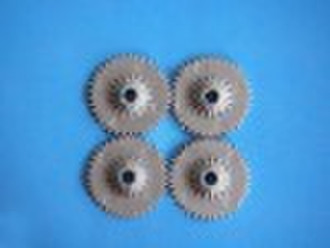
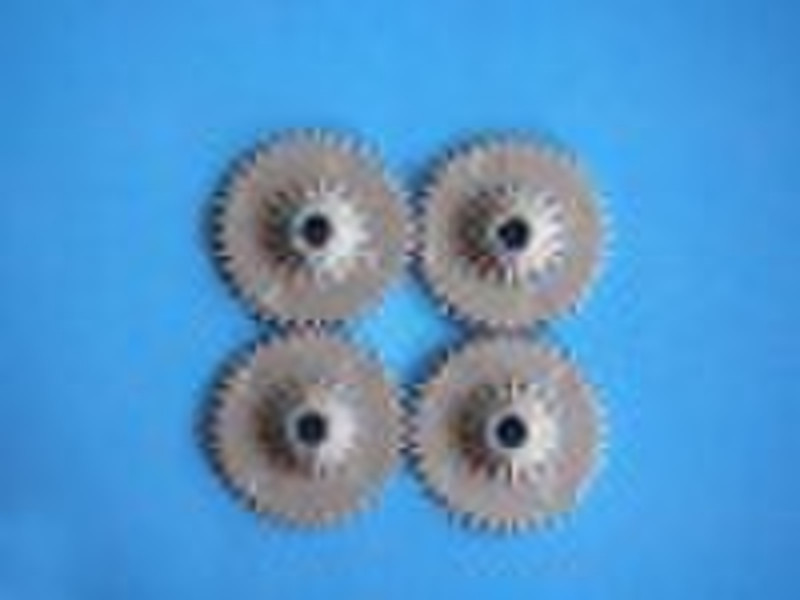
gear(MIM)
original price: 0,10 USD


Chunqiang Ma
Contact person
Basic Information
| Place of Origin | Henan China (Mainland) |
|---|---|
| Model Number | all |
| Brand Name | QXT |
| Material | Stainless Steel |
| Standard or Nonstandard | Nonstandard |
Metal injection molding offers a manufacturing capability for producing complex shapes in large quantities. The process utilizes fine metal powders (typically less than 20 micrometers) which are custom formulated with a binder (various thermoplastics, waxes, and other materials) into a feedstock which is granulated and then fed into multiple cavities of a conventional injection molding machine. After the “green” component is removed, most of the binder is extracted by thermal or solvent processing and the rest is removed as the component is sintered (solid-state diffused) in a controlled atmosphere furnace. The MIM process is very similar to plastic injection molding and high-pressure die casting, and it can produce much the same shapes and configuration features. However, it is limited to relatively small, highly complex parts that otherwise would require extensive finish machining or assembly operations if made by any other metal forming process. Material Designation CodeDensityHardnessTensile StrengthElongationg/cm3HRMpa%Low Alloy SteelMIM-2200 (As-sintered Condition)7.6545HRB29040.0MIM-2700 (As-sintered Condition)7.6569HRB44026.0MIM-4605 (As-sintered Condition)7.6262HRB41515.0MIM-4605 (Heat Treated Condition)7.6248HRC16552.0StainlessSteelMIM-316L (As-sintered Condition)7.6267HRB52050.0MIM-17-4PH (As-sintered Condition)7.5027HRC9006.0MIM-17-4PH (Heat Treated Condition)7.5033HRC11856.0MIM-430L (As-sintered Condition)7.5065HRB41525.0Soft Magnetic AlloyMIM-22007.6045HRB29040.0MIM-Fe-50%Ni7.7050HRB45530.0MIM-Fe-3%Si7.4580HRB53024.0MIM-Fe-50%Co7.7080HRB205<1.0MIM-430L7.5065HRB41525.0
Delivery terms and packaging
Packaging Detail: paper box or wooden box Delivery Detail: within 30 days after signing of contract
Port: Tianjin/ Qingdao
Payment term
Letter of credit
Telegraphic transfer

-
Payment Methods
We accept: